

The "Kitchen Sink" Go Box: Tuning, Turmoil, and Solar Tantrums
TL;DR: Real-World Verdict
The ATAS-120A is a fantastic bit of kit when it has a massive hunk of steel (your car) as a ground plane. Trying to trick it into working on a tripod is like trying to balance a budget—painful and usually unsuccessful. Get it low, get it coupled to the earth, and pray the Sun isn't in a foul mood.
At Tuesday’s GARC meeting, I finally hauled out my latest "shack-in-a-box" project: a versatile Go Box built around the venerable FT-857D. It’s the Swiss Army knife of radios, and I wanted a housing that treated it as such.
The brief was simple, or so I told myself:
-
Boot-to-Mobile: It needs to live in the car, tethered to the remote head and the vehicle's antenna without requiring a degree in cable management every time I want to go mobile.
-
Rapid Deployment: If I see a decent hilltop or a Field Day invite, I want to be on the air before my tea gets cold.
The ATAS Ambition
Since I’m already running the ATAS-120A on the car, I figured I’d stick with it for portable work. Yes, it’s a "compromise" antenna, but carrying a full resonant dipole for every band is how you end up with a chiropractor on speed dial. To hedge my bets against stubborn loads, I’ve also tucked a MAT-30 tuner into the kit as a backup.
Attempt 1: The Tripod Failure
My first bright idea was mounting the ATAS on a tripod. I threw eight radials at it, expecting a perfect match. Result? Absolute rubbish. RF is a lot like water; it wants to find the easiest path, and my tripod was basically an island. The ATAS was screaming for a better ground plane, and the height of the tripod was just introducing unwanted reactance. If the physics don't want it to work, no amount of button-mashing on the 857 will save you.
Attempt 2: The "Low and Slow" Approach
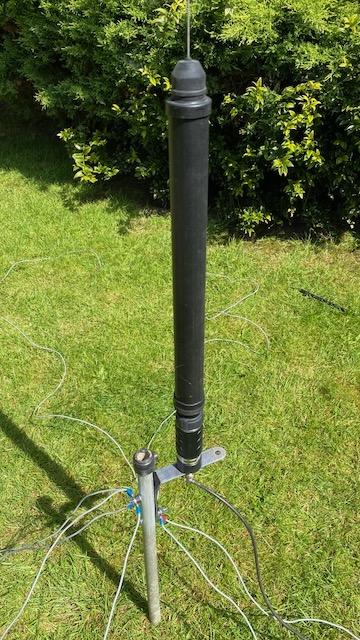
For the second go, I ditched the height. I repurposed a section of an old telescopic pole as a ground spike and bodged together a mount using an L-bracket and a crusty old car mount I found at the back of the garage (a true "junk box" special).
The Specs:
-
Mount: Earth-driven spike with L-bracket.
-
Counterpoise: 8-radial web (reused from the tripod disaster).
-
Performance: Flawless tuning from 40m all the way up to 70cm.
-
SWR: Flat as a pancake across the range.
When the Sun Intervenes
Just as I was patting myself on the back for defeating the SWR gods, the bands went dead. Total silence. I spent ten minutes checking my crimps and cursing my coax, only to find out it wasn't my engineering—it was the Sun. A solar flare decided to trigger a radio blackout right at the peak of my testing. You can build the best Go Box in the world, but you still can't compete with a literal star having a tantrum.
What’s Next?
The next trial involves a local playing field to see how it handles a "real" environment away from the interference of my domestic QRM. I’ll also have the full kit on display at the Grantham College community event this Tuesday. Come along and see the cable ties in person.
73,
MarkC – G5MDC
Got a Go Box that’s more 'Go' than 'Box'? Or perhaps you’ve found a way to make the ATAS behave without burying half a scrapyard? Drop a comment below—I’m always looking for ways to make my gear lighter and my signals stronger.
0 Comments